
 Share



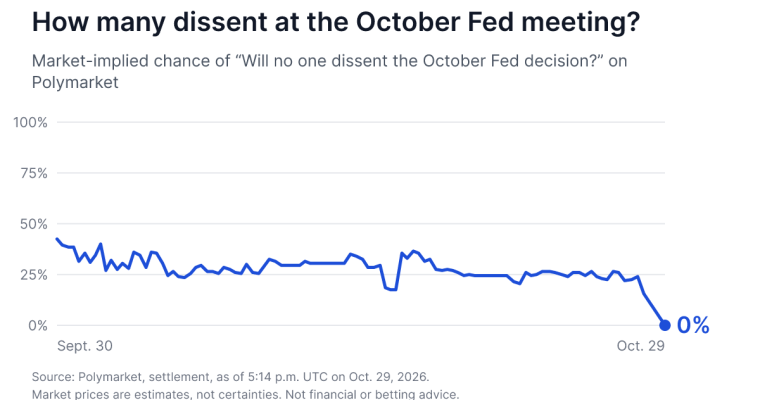
The Federal Open Market Committee approved its October 28, 2026, statement by a 10 – 2 vote, according to the Federal Reserve, putting the 2 dissenting votes 2 votes above the zero-dissent requirement for a unanimous decision. Polymarket’s “Will no one dissent the October Fed decision?” contract settled at 0% as of Thursday afternoon ET, a resolved NO outcome rather than a forecast.
Key takeaways
- The Federal Reserve recorded a 10 – 2 vote on October 28, defeating the zero-dissent outcome.
- The contract moved from 21% on Oct. 22 to a resolved NO settlement.
- Cook and Hammack preferred a rate increase of 1/4 percentage point rather than holding rates steady.
- The next FOMC meeting is December 8-9, 2026, but its decision cannot change the October settlement.
The contract moved from 21% on Oct. 22 to 0% at settlement. Those endpoints show the change from a pre-decision market-implied chance to a completed result. They do not show whether the intervening move was a jump or a gradual decline.
The new development since this site’s October 28 coverage is the recorded vote and the contract’s resolution. The question is no longer whether the October decision will attract dissent, but how the official result fits the contract.
The October statement supplied the deciding vote count
The contract asked how many FOMC members dissented on the federal funds rate decision at the October 27–28, 2026, meeting. The no-dissent outcome required zero dissenting votes, with resolution based on the votes recorded in the FOMC statement after that meeting. The rules set no separate resolution deadline.
The Federal Reserve named Lisa D. Cook and Beth M. Hammack as voting against the monetary policy action. Both preferred to raise the target range by 1/4 percentage point, while the committee decided to hold rates steady.
That distinction matters to the contract’s interpretation. This was a question about agreement on the rate decision, not simply whether the Fed would change rates. Holding rates steady did not satisfy the unanimity condition because the statement recorded opposition to that action.
December’s rate decision is a separate question
Axios, citing CME’s FedWatch tool, and Reuters both reported market pricing that favored a rate increase at the December meeting. Those readings concern the next meeting’s policy action, not the number of dissenters at October’s meeting. They therefore offer no directly comparable probability gap with this settled contract.
The Federal Reserve calendar lists December 8-9, 2026, as the next scheduled FOMC meeting. That decision can answer a new policy question, but it cannot move the completed October contract toward or away from its zero-dissent requirement. A unanimous December decision or another divided vote would concern a different meeting.
—
Sources: As reported by Federal Reserve, CNBC, Reuters and Axios.
Market data: Polymarket, settlement as of 5:14 p.m. UTC on Oct. 29, 2026.
Prediction market prices reflect the collective estimates of traders, not certainties. This is not financial or betting advice.