
 Share



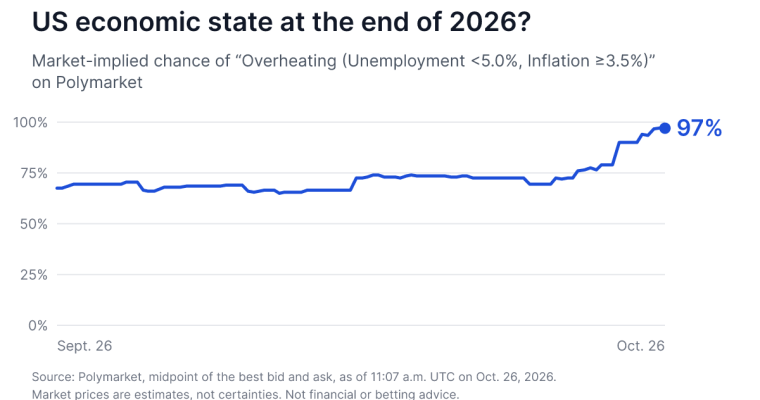
The U.S. unemployment rate was 4.2 percent in September 2026, according to the Bureau of Labor Statistics—0.8 percentage points below the 5.0% boundary for the year-end “Overheating” test. Polymarket’s Overheating contract showed a market-implied chance of 97% as of Monday morning ET.
Key takeaways
- September unemployment clears the contract’s labor-market condition, but it is not the year-end reading.
- The contract also requires inflation of at least 3.5%; no inflation reading here establishes that condition.
- Weekly trading volume was $13,609, versus a $3,600 weekly average over the past month.
- Reuters’ unemployment forecast measures a multi-year average, not the contract’s joint year-end outcome.
That price concerns two conditions holding together: unemployment below 5.0% and inflation at least 3.5% at the end of 2026. September’s unemployment reading satisfies the first condition for that month, not for year-end. The available economic evidence does not include an inflation reading that establishes the second.
The repricing was sharp, with trading above its recent baseline
The Overheating contract rose from 68% on Sept. 25. Its largest move within 48 hours was from 79% on Oct. 23 to 94% on Oct. 25, a 15-point jump. The latest price also matches its 30-day high.
Trading was substantially busier than its recent baseline. Weekly volume reached $13,609, compared with a $3,600 weekly average over the past month, or 3.8 times that average. Those figures show increased activity alongside the repricing; they do not explain why participants changed their estimates.
The neighboring contracts show how differently traders price the other combinations. Polymarket’s Soft Landing contract, requiring unemployment below 5.0% and inflation below 3.5%, was priced at 2% as of Monday morning ET. Its Slack contract, requiring unemployment at least 5.0% and inflation below 3.5%, was priced at 0% as of Monday morning ET.
The contrast is especially clear between Overheating and Soft Landing: both require unemployment below the same boundary, but they sit on opposite sides of the inflation threshold. The unemployment report alone cannot distinguish between them.
The outside forecast covers only part of the year-end test
Reuters reported that economists projected an average unemployment rate of 4.3% over the coming years. That forecast is consistent with unemployment remaining below the contract’s boundary, but it measures a multi-year average rather than a single year-end reading.
It also says nothing about whether inflation will meet the Overheating condition. The market price estimates the chance of both requirements holding together; the Reuters figure is a forecast of one economic measure. There is no comparable numerical probability gap to calculate between them.
The contract’s horizon is the end of 2026. Its stated rules do not identify an exact resolution date or specify which inflation measure applies. That limits how precisely the inflation requirement can be checked against a future release.
Either threshold could prevent an Overheating resolution
Overheating would fail if unemployment were at least 5.0% or inflation were below 3.5% at the end of 2026. Both conditions must hold for the contract to resolve affirmatively.
The latest unemployment observation therefore supports only one part of the test. It cannot establish the joint outcome, and the absence of an inflation reading leaves the other part untested.
October and November releases add labor-market evidence
BLS has scheduled its September Metropolitan Area Employment and Unemployment release for Oct. 28 at 10:00 a.m. ET. Lower metropolitan unemployment would provide indirect context consistent with the national rate staying below 5.0%; higher readings would point in the opposite direction. Neither directly tests the national threshold.
The October State Employment and Unemployment release is scheduled for Nov. 20 at 10:00 a.m. ET. If it includes an updated national rate, a lower reading would widen the cushion below 5.0%, while a rise toward that boundary would narrow it. A reading at or above 5.0% would fail the unemployment condition for that month—not settle the year-end contract.
—
Sources: As reported by U.S. Bureau of Labor Statistics and Reuters.
Market data: Polymarket, midpoint of the best bid and ask as of 11:07 a.m. UTC on Oct. 26, 2026.
_Prediction market prices reflect the collective estimates of traders, not certainties. This is not financial or betting advice._